

What is keeping your company from successfully adopting and utilizing AI, GenAI, and Agentic AI?
Three days ago, we passed the third anniversary of the launch of ChatGPT. During that time, there has been an explosion of innovative new AI products, services, and solutions that have far outstripped successful employee and end-user adoption and utilization. The following data documents the gap between the level of innovation and adoption:
-
- A recent MIT report states that 95% of AI pilots fail to provide a return on investment, largely due to poor integration with existing workflows and a lack of workforce skills.
1.Only about 5% of pilots have made it into production with measurable value.
-
- In an IDC 2024 study, 70% of CIO’s reported a 90% failure rate from their custom-built GenAI app projects and 66% reported a 90% failure rate with vendor-led proof-of-concepts.
- A 2025 Manpower Group survey found 70% of organizations are struggling to find skilled workers to fill roles in AI, GenAI, and Agentic AI.
- A 2025 IBM CEO Survey showed 64% of CEO’s said they invest in AI mainly to avoid falling behind competitors.
- In a 2025 survey from Harvard Law School Forum on Corporate Governance they documented
1. 66% of boards have limited or no knowledge of AI
2. 31% of boards do not have AI on their agendas
3. 40% are rethinking board composition due to AI
- A 2025 Accenture AI readiness study showed that only 16% of companies are “reinvention-ready” with fully modernized data foundations and end-to-end platform integration to support AI driven innovations across most business processes.
Like most new disruptive technologies, to adopt and deploy AI, GenAI, and Agentic AI successfully requires a clear understanding of what end result you want to achieve and how AI can help you achieve it. It also requires a realistic assessment of what resources and budgets you need to achieve those outcomes.
As the data above highlights, without a series of foundational operating and governance systems and processes in place, there is little or no chance for successful adoption.
If your employees aren’t adopting and utilizing AI, then it’s unlikely your customers will either
Numerous studies have documented that the vast majority of AI projects over the past several years have failed to achieve their desired outcomes. Much of that failure has been the result of a large percentage of companies who have not been successful in getting their employees to adopt and utilize it.
- A recent McKinsey study documented that:
1. Just 11% of companies have adopted AI at scale
2. Only 15% of companies are seeing AI have a meaningful impact on their financial performance - A Forbes study documented that:
1. 75% of companies said they are having difficulty in finding qualified candidates to develop and manage their AI program
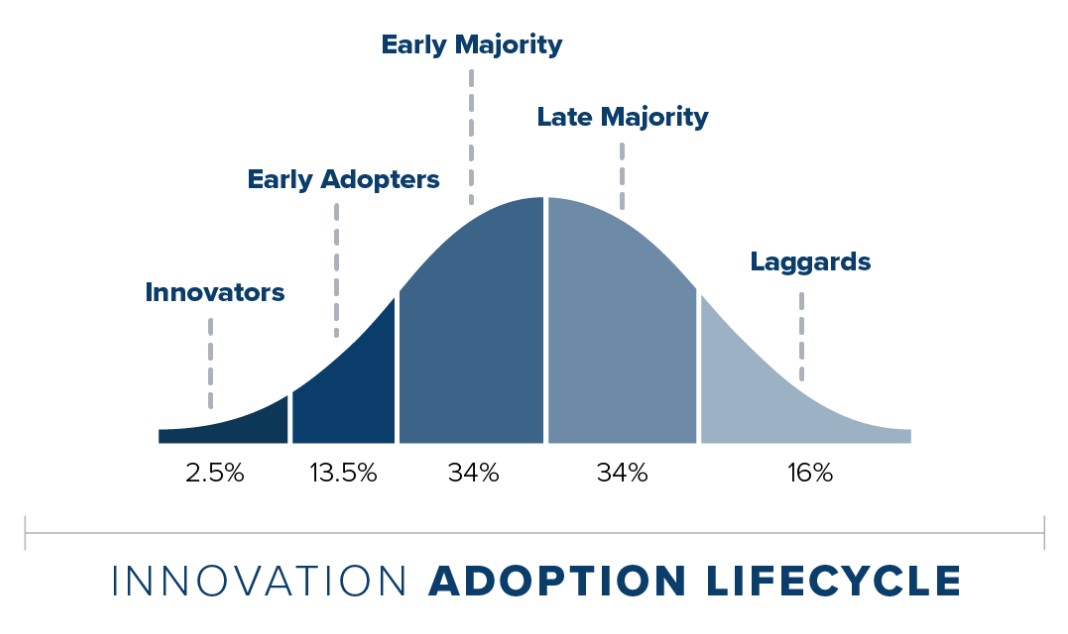
In his book Crossing the Chasm, my brother Geoffrey Moore’s initial focus was on helping early-stage companies successfully scale into the mainstream market. The Innovation Adoption Lifecycle chart shown above is the foundational framework to successfully drive adoption across that lifecycle. What it illustrates is that any time a new disruptive technology like AI, GenAI, or Agentic AI is introduced, the market self-segments into different categories with very different adoption motivations.
The primary reason for low employee adoption is that companies treat all their employees as if they have the same motivation to adopt, while in fact, like the customer market, they too have very different motivations depending on where they fall on the innovation adoption lifecycle. To drive widespread employee adoption and utilization you need to align your internal employee adoption program with these three primary segments and what motivates each one to adopt and utilize a new digital technology:
Early Adopters – Visionaries are motivated by any opportunity to improve their performance and are very comfortable starting with a minimum viable product (MVP) that they think greatly improves their current job function and responsibilities. They are also willing to provide input and feedback on how the product, service, or solution can be enhanced and expanded.
Early Majority – Pragmatists are only motivated to adopt when they see fellow pragmatists who are trying to solve a similar job performance problem or process bottleneck. They also want a whole product or solution, and they never use early adopters as references because they don’t have the same desired outcomes.
Late Majority – Conservatives are motivated when they see multiple successful use case examples and well-established processes that they feel very certain will do what they want done.
While the initial focus of this work was aimed at the external market, it is now proving to be extremely helpful in getting internal company employees to adopt and utilize new digital technologies like AI. Simply put, if your own employees are not motivated to adopt AI then it is very unlikely that your customers will be motivated to do so.
Unlocking trapped value in legacy systems, processes, and workflows is the first step to scaling adoption of new digital technologies

I have recently developed a three-part framework to help companies self-fund new investments in AI, GenAI, and Agentic AI by unlocking trapped value in their legacy systems, processes, and workflows.
Part one starts with a discovery assessment to document how much of the company’s current budget and resources are allocated to running the business they have vs. growing the business they want. In almost every case it averages 80% run and 20% grow. Which begs the question, what would the ROI impact be for the company if this equation was flipped to 40% for run and 60% for grow?
Part two is a facilitated trapped value recovery workshop which identifies legacy systems, processes, and workflows that can be updated (modernized), consolidated, or eliminated.
Identify Company Bottlenecks:
- How many siloed operations & supply chain systems are in use?
- Procurement, logistics, production, others
- How many customer database management systems are in use?
- Sales, marketing, customer support, others
- How many redundant application suites are in production?
- How many legal, risk, and compliance functions remain spreadsheet-driven and manually reconciled?
Prioritize trapped value recovery projects that can deliver returns in 30–90 days
- Legacy systems & processes that can be updated
- Move from on premise to the cloud
- Legacy systems and processes that can be consolidated
- Individual customer databases into one meta-data resource
- Legacy systems and processes that can be eliminated
- Technical debt and redundant applications
Assign implementation accountability
- Each prioritized recovery project is assigned to one of the workshop participants who will be accountable for its timely implementation
- They will develop a project implementation plan and 30–90-day timetable
- Implementation progress will be reviewed on a weekly basis
Part three is a facilitated workshop that creates a digital technology investment roadmap that prioritizes projects that align with the company’s overall growth goals and ROI metrics.
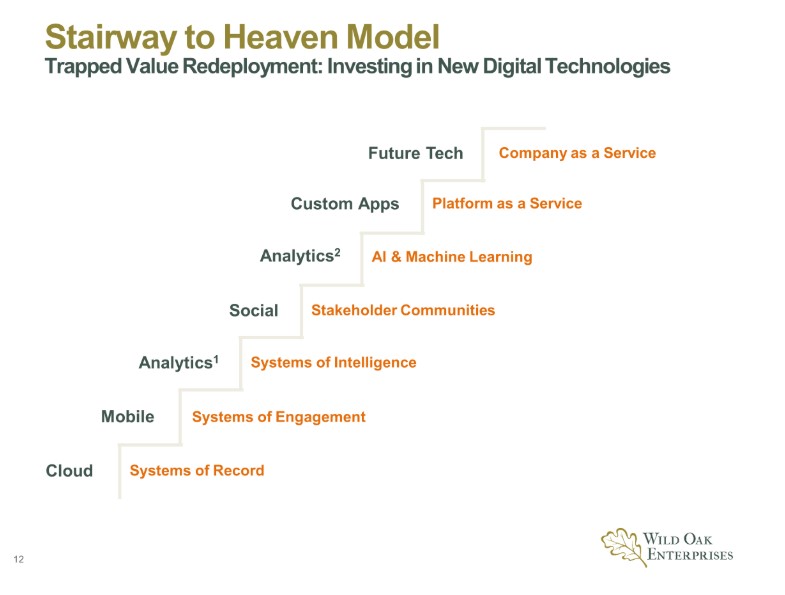
- Utilize the Stairway to Heaven framework to build the roadmap
Use the Stairway to Heaven Model to identify where recovered resources can be reinvested. Make sure the early steps on the stairway are in place before making investments in the next steps.
The reason so many AI, GenAI, and Agentic AI projects have missed their desired outcomes is because they weren’t in service to solving a specific problem and taking advantage of a specific opportunity. They were mostly about deploying a new technology before anyone really understood what it could do and what kind of organizational and operational preparation you must have in place to do it.
To avoid this trap, start with the most important questions that help C-Suite executives and other senior leaders learn what they need to know to make good decisions. A key role these questions play is to help determine what the company should be doing and what it should not be doing. They also allow leaders to identify which things the company can’t do now but needs to learn going forward.
Here are some core foundational questions which should be asked over and over:
- How does our company create value?
- Do we have the necessary skills and capabilities to deliver that value?
- What could disrupt or dilute that value?
- How can we increase or enhance that value?
The thoughtful pursuit of the sometimes-evolving answers to these questions enables senior leadership teams to fully understand and commit to a portfolio of AI, GenAI, and Agentic AI innovation projects that the company is fully prepared to successfully adopt & utilize.
As always, I am interested in your comments, feedback and perspectives on the ideas put forth in this blog. Please email them to me at pdmoore@woellc.com. And, if this content could be useful to someone you know, please share it here: